Tuesday, August 11, 2009

Should NS be Reduced or Scrapped

Should NS be Reduced or Scrapped

See also, discussion on http://forums.hardwarezone.com.sg/showthread.php?t=2038383

NATIONAL SERVICE


Introduction

National Service, or army conscription in Singapore, was first introduced in 1967 due to pressing issues such as national security after Singapore's "forced" independence in 1965. In 1971, the British completely pulled out of Singapore. It has been 41 years since the introduction of NS.

Since then the world and Asia has changed significantly in terms of security and economic arrangements. But has Singapore's conscription policy kept up with these changes to reflect and cope with the new geopolitical landscape?

First let us review the service that all able-bodied 18-year-old male Singaporeans have to undergo. Basic Military Training, or BMT, is the "boot camp" for all new recruits. This lasts for three months whereupon the soldier then gets posted out to other units for further specialised training.

The conscripts then serve the remainder of their two-year stint polishing up their combat skills. Following the two years of full-time service, NSmen are required (for up to 40 days a year) to serve in a part-tme capacity until they are 50 years old for commissioned officers and 40 for others.

Reduce the two-year full-time service

In an age where warfare has turned to "smart" technology, is it still logical and necessary for Singapore to insist that its National Servicemen undergo 24 months months of active, full-time service? Such a policy is rare among countries that maintain a conscription policy. Below is a list of countries with periods of full-time conscript service:

1.Austria (6 months)
2.Bolivia (12 months)
3.Brazil (9-12 months)
4.Denmark (4-12 months)
5.Estonia (8-11 months)
6.Finland (6-12 months)
7.Germany (9 months)
8.Greece (12 months)
9.Guatemala (12-24 months)
10.Moldavia (12 months)
11.Mongolia (12 months)
12.Paraguay (12-24 months)
13.Poland (9-12 months)
14.Serbia (6 months)
15.Switzerland (18-21 weeks)
16.Taiwan (12 months)
17.Tunisia (12 months)
18.Turkey (12 months)
19.Ukraine (12 months_
20.Uzbekistan (12 months)

From the above data, it can be seen that for all intents and purposes a conscript army training programme need not be as long as the one we have in Singapore. The more advance countries like Austria, Denmark, Germany, Greece, and Switzerland all have full-time services limited to one year and less.

Even Taiwan, which has an identifiable enemy in the form of China, limits its active service to 12 months. Only countries like South Korea and Israel have conscription periods that are longer than Singapore's. These countries are, however, in a state of war.

Given the situation in Singapore there is no reason why we cannot employ more efficient training methods and reduce full-time NS from the present two-years to twelve months or less.

Reservist training

The current period of reserve training for NS men of up to 40 years old is also a burden on the servicemen and, by extension, the economy. Not only does the serviceman have to contend with the influx of foreigners, they are disadvantaged in terms of employment, remuneration and promotion when employers compare local men who have to be away for weeks in anyone year with foreign workers who have no such obligation.

The span of a serviceman's reservist training should not go beyond 30 years of age. Men tend to settle down and start families around this age and job stability and carreer prospects are essential during this period. Unfair competition from foreign nationals would handicap local males and add to their already stressful lifestyles.

In addition, the human body goes into a physical decline after the age of 30. To keep our military personnel in top condition, it makes little sense in keeping men over the age of 30 in the frontline if military conflict does indeed breakout.

Increase volunteer, professional army

To compensate for the decrease in the number of active and reservist NSmen, the Singapore Armed Forces should expand volunteer army recruitment to complement the reduction in the number of conscripts.

In fact, the number of countries that have scrapped conscription are on the rise: Argentina (1994), Belgium (1994), Czech Republic (2004), France (1996), Hungary (2004), Italy (2004), Netherlands (1996), New Zealand (1972), Portugal (2004), and Spain (2001).

While Singapore may not be ready to follow suit, it would be prudent for us to reduce NSmen in favour of a professional military outfit

At the moment, NSmen are exploited for their services to glorify the PAP during National Day parades. The energy and time of these men can be put to more productive use than as entertainment for the PAP regime.

Conscientious objectors

What about people who do not believe that it is right for them to do military service due to moral, religious or ethical grounds? At the moment such conscientious objectors are charged and imprisoned for the length of their service.

In some of the countries that have compulsory military service, there is also a provision for conscientious objectors to serve in non-combat roles. There is an argument that this would open the flood gates for men to opt for non-combat positions. Such a loophole can be plugged by increasing the length of active service by, say, six months. The experiences of other countries like Germany and Sweden have not been negative in this aspect where males try to avoid combat service by claiming to be conscientious objectors.

Tranparency and openness

Obligation in Singapore seems to be a one-way street. While the Government holds the people accountable for their NS liabilities, the Ministry of Defence remains non-transparent and non-accountable in their dealings with the public.

The recent deaths of National Servicemen have opened a can of worms on training safety. In addition, the number of training fatalities and injuries are not made known to the public as a matter-of-course. The Government which compels the people to give their lives for the country are obliged to be absolutely transparent with information pertaining to safety issues. Compensation for deaths and injuries must also be reviewed and revised upwards.

The Government must also not exploit NSmen as cheap labour during major events such as the WB-IMF meeting or, possibly, the upcoming Youth Olympics. In must be remembered that the Enlistment Act was enacted for a specific purpose and any detraction from that purpose must be shunned.

Conclusion

When citizens are forced to serve in the military with the possibility of being killed if called to war, it is imperative that the government is a democratic one where citizens can hold the government accountable for its decisions and actions. Otherwise we may end up in a situation where wars are waged for the ruling elite rather than for the security and sovereignty of the nation.

http://forum.yoursdp.org/viewtopic.php?f=4&t=3

Sunday, August 9, 2009

what-ns-has-done-for-me

http://singaporeanskeptic.blogspot.com/2009/08/what-ns-has-done-for-me-sleeping-on.html

what-ns-has-done-for-me
"Looking back, I am glad I went through NS. Because of NS, it forced me to work harder, seek opportunities abroad and settle down overseas. I met a friend of mine who once commented that Singaporeans have a high tolerance for abuse by the government. It is like someone hits you, you complain but you take more beatings and after a while, you get used to it. The issue is not about the 'privilege' of being a Singaporean, but that many Singaporeans lack the courage to do something about it." -John

This is a comment from John regarding a recent post about NS. Skeptic wonders if it is the same commentor who talked about finding a job overseas. Anyway, what he said stirred up my own personal bad memories of NS.

To be honest, I wasn't so keen on leaving Singapore until I myself suffered 2.5 years of NS. Up till then, I had experienced many bad things growing up but it seemed that NS was the tipping point. This makes me wonder whether, for some of us, NS makes us less patriotic rather than more.

Like the commentator, the pain and humiliation I suffered in NS made me more resolute in seeking my future away from Singapore. So if you are right now suffering under the system, my advice to you is to channel your resentment and anger towards something more productive. Use that energy to develop skills that would make you valuable outside of Singapore. Pretend to love the PAP system but plot to leave. Develop your abilities and resources so that you can one day become a productive citizen in another country.

I suppose the best phrase to describe it is the Chinese idiom 卧薪尝胆 which means 'steeling oneself for bitter revenge'. The best form of revenge is to lead a successful life abroad and deprive the PAP system of your abilities.

Note to non-Chinese speakers: There is a very interesting story behind the phrase 卧薪尝胆 which literally translates as 'Sleeping on Brushwood and Drinking Gall'.

Friday, August 7, 2009

Make English and modified NS a must

Yah, like the government will tell the PRs to serve part-time NS. After all, these 'talents' are here to enjoy our work environment at the expense of 'less talented' Singaporeans and not to defend the country. Money, money, money.


Make English and modified NS a must
http://www.straitstimes.com/ST%2BForum/Story/STIStory_413578.html

SUNDAY'S reports, 'Mah urges new citizens to adapt to local ways' and 'Be mindful of racial, religious fault lines', bring to mind two measures that may encourage meaningful integration of naturalised citizens with 'true-blue Singaporeans'.

National Development Minister Mah Bow Tan, in calling on new citizens to make an effort to become 'true-blue Singaporeans', said he noticed that some new citizens appear to make no conscious effort to integrate or learn spoken English.

This prompts the question: Why are we giving citizenship to people who cannot communicate in Singapore's lingua franca?

Most naturalised citizens come from China. While they can converse in one official language, they are not equipped to have any meaningful interaction with minority Singaporeans and Chinese Singaporeans who do not speak Mandarin.

Not surprisingly, Mr Mah is concerned about new citizens forming cliques in their own communities.

To reduce the likelihood of ethnic enclaves becoming a problem, the Government should require future citizenship applicants to pass an English language test.

Pointing out the threat of racial and religious disharmony to Singapore's stability, Deputy Prime Minister Wong Kan Seng said the Government's key approach to managing race and religion matters is to build common spaces in schools, communities, workplaces and national service.

However, national service is one area in which adult new citizens currently do not participate, and the Government should introduce a modified, shortened form for adult new citizens under the age of 40.

While it is true that they did not enjoy the benefits of citizenship during their childhood, they will enjoy these benefits for the rest of their lives.

They could learn the basics of army combat, policing or civil defence over a predetermined number of weekends, a practical compromise given work commitments.

Besides helping them integrate better with their new compatriots, the modified national service stint will also empower them to play an active role in Singapore's national defence or internal security.

After all, the enemy's bullet or bomb does not distinguish between naturalised and native-born Singaporeans.

Michael Ang

Sunday, July 26, 2009

NSF gets five days’ detention

Mindef needs to catch with the rest of the world with conscription and permit Conscientious objectors alternatives. Must Singaporeans always conform to the standards of military life in NS?

What about people who do not believe that it is right for them to do military service due to moral, religious or ethical grounds? At the moment such conscientious objectors are charged and imprisoned for the length of their service.

In some of the countries that have compulsory military service, there is also a provision for conscientious objectors to serve in non-combat roles. There is an argument that this would open the flood gates for men to opt for non-combat positions. Such a loophole can be plugged by increasing the length of active service by, say, six months. The experiences of other countries like Germany and Sweden have not been negative in this aspect where males try to avoid combat service by claiming to be conscientious objectors.

NSF gets five days’ detention

Channel NewsAsia - Sunday, July 26

SINGAPORE: A full—time National Serviceman was summarily tried on Friday under the Singapore Armed Forces Act for conduct prejudicial to good discipline. He was sentenced to five days’ detention at the SAF Detention Barracks.

Private Madana Mohan Das, a trainee driver, was charged with misconduct because he did not comply "with his superior’s lawful orders to cut his hair in conformance to SAF’s requirements and for refusal to consume food provided by the SAF", said Colonel Darius Lim, director of public affairs at the Ministry of Defence.

The sentence was backdated to Monday, when Pte Madana was put under close arrest. He has since complied with the requirements and was released from detention on Friday afternoon and returned to his unit.

Before being charged, he was given "ample opportunities" to cut his hair and to eat the food provided by the SAF, and his "repeated acts of misconduct" were "undermining discipline in the SAF", said Col Lim in reply to media queries.

"All SAF servicemen are to abide by SAF rules and regulations on military turnout and bearing, military discipline and lawfully given orders. Pte Madana was treated in the same way as any other SAF serviceman," he said.

"The SAF cannot allow deviations from its rules and regulations for any serviceman as this will weaken military discipline, which could compromise the SAF’s operational effectiveness and the safety of SAF servicemen. Disciplinary action will be taken against any serviceman who refuses to comply with the SAF’s rules and regulations."

TODAY has learnt, though, that during his Basic Military Training in December, Pte Madana’s unit accommodated his requests to keep his tuft of long hair, which he wanted to maintain because he was a Brahmin priest at a temple here. The unit also allowed his request to have home—cooked food to be delivered to him daily.

But these "accommodations were a mistake due to a lapse of judgment by his previous unit", Col Lim told TODAY, and when Pte Madana was posted to the SAF Transport Hub in March, this was explained to him.

His and his father’s appeals were rejected and the NSF was ordered to conform to SAF regulations, which he did not, added Col Lim.

TODAY understands he brought in food from the temple when he booked out on Tuesday and Thursday evenings and on weekends, since he did not consume SAF food.

Singapore Brahmin Association president G Srinivasan told TODAY that Brahmin priests ordinarily eat only food cooked from their temple, "prepared according to tradition and with prayers".

But while he was "a bit" concerned to hear about Pte Madana’s case, he said that if this food is not available, "then food from outside is permissible as long as it is vegetarian from an acceptable source, like a vegetarian restaurant, house or temple".

He also said that while it would have been good if Pte Madana could have kept his hair, known as a sikha, the NSF would have to "follow the rule of the land" if there are no provisions for this.

Asked why exceptions are made for Sikhs serving NS, Col Lim said: "Sikhs serving in the SAF are allowed to wear turbans only because this is a carry—over from the past.

"This is a long—established practice going back decades to colonial times. We cannot allow further exceptions to be made today for other servicemen. Allowing further exceptions would undermine what we have achieved so far to make sure that our rules, regulations and standards are fair to all.

"This will be detrimental to not only the security needs of the nation, but will also weaken the strong national identity that NS forges amongst its servicemen." — TODAY/ra

Friday, July 24, 2009

Mum wants to ban NS men from taking buses


Mum wants to ban NS men from taking buses

http://www.facebook.com/ext/share.php?sid=106544671793&h=1NQZg&u=JzZiV&ref=nf

A Netizen who claimed to be a mother of two girls made a post in an online forum recently, demanding that NS men be banned from taking public buses because they are dirty and smelly.

The post drew furore from other forum members, who have called the poster insensitive and disrespectful towards NS men.

The Netizen, who goes by the username JusticeLegal, described an unpleasant bus ride on 10 July which prompted her to propose the ban.


JusticeLegal said that she was bringing her children home from Downtown East when a group of "army boys" boarded the bus with them. The NS men were sweaty and smelled, and soon the Netizen's daughters were "making sick faces" at her.

The Netizen proposed that SAF ban soldiers from taking the bus, reasoning that the pay NS men get should be enough to pay for taxi rides.

She also said that the soldiers, having just returned to Singapore from Tekkong, might have contacted "germs and viruses" and might spread the diseases to others.

Calling the NS men "smelly green things", JusciceLegal said in her post that her two daughters should be spared the eyesore.

If she had a grandson in the future, the Netizen said that she would teach him to be a responsible citizen and take a cab, or wait for her to fetch him.

The forum thread, which has since attracted some 900 replies, was started on 17 July. A large majority of replies expressed anger at JusticeLegal's comments with many saying that the Netizen should at least recognize the contributions of NS men.

See sgforums link http://politics.sgforums.com/forums/10/topics/368533


Tuesday, July 7, 2009

If I am a Malaysian

The paragraph below was pulled from this letter and it really frustrates me that the government is saddling our Singapore males with NS and reservist training as well as yearly IPPT. In today's competitive environment and I'm talking about the private sector, a moment's delay can mean a make or break business deal. How many NSmen have lost opportunities in life and for what? A thank you note from MINDEF? Thanks but no thanks. This PR made a smart move as he was willing to move out of his comfort zone, he reaps the benefits of this move. What about us Singaporeans? What can we do? Move to JB, PR in Malaysia? Ironic isn't?

"Unfortunately, our greatest selling point to foreign talents is also dissuading them from settling down here permanently. What additional advantages does being a citizen have over a PR?

I failed my last IPPT and has to go for remedial training thrice a week. Can you imagine the hassle and torture of reporting to Khatib Camp to run 2.4km after a long and hectic day? Due to my frequent travels, I have to apply for deferments often. There was once I forgot and I received a letter from SAF almost immediately threatening to charge me.

My relative, however, have no such concerns. He has zero NS obligations at all - no ICTs, RTs, mob-manning and whatsoever. He can concentrate fully on his work and career. He does not care a bit about local politics. His aim is simply to make money here. His son is born in Malaysia, but studying in Singapore. He need not worry about him having to go through NS when he grows up.

Foreigners flock to Singapore in search of a better life. If they are willing to turn their backs on their homeland and become Singapore citizens in the first place, how patriotic can they be? How many of these new citizens give up their pink ICs later?

J.F. Kennedy once said: “Ask not what your country can do for you. Ask what you can do for your country.”

Most Singapore males have served 2 years of national service followed by over 10 years of reservist training. Are we getting a fair deal from our country?"


http://wayangparty.com/?p=10426

If I am a Malaysian

July 8, 2009 by admin

By Fang Zhi Yuan

There are a few letters to the Malaysian media lately from Malaysian PRs and Singapore citizens whose parents are Malaysians about the ugly side of Singapore which has sparked a furore amongst Singaporeans who are indignified by the “ingratitude” shown by their brethen across the causeway.

What if I am a Malaysian working in Singapore? How will I plot my future and that of my children? Will I take up the Singapore citizenship or continue being just a PR to enjoy the best of both worlds?

Let’s imagine I was born in a middle class Chinese family in Johor Bahru. My family is not exactly that rich, but pretty well off by ordinary Malaysian standards.

My father run a small family business, like the majority of the Chinese in Malaysia and I live in a terraced house on the outskirts of the city.

After finishing my primary education in Johor, I was sent packing to continue my secondary education in Singapore. I went through the Singapore education system till university where I graduated with a Bachelor degree in Engineering.

As a Malaysian with no National Service obligations, I entered the workforce two years earlier than my Singapore counterparts. Within 6 months of working, I was offered to take up Permanent Residency in Singapore which I gladly obliged.

Singapore has been good to me. It gave me an education, a job and a future, opportunities which I will never be able to get in Malaysia as a result of the racist bumiputra policy.

Two years later, I was invited to become a Singapore citizen which threw me into a dilemma as I will have to give up my Malaysian citizenship, not that I was particularly loyal to my country of birth.

Malaysia has always been close to my heart though the government does not treat the ethnic minorities particularly well.

My parents, relatives and friends are all in Malaysia. There is a kampung spirit and human touch which is absent in Singapore. Despite living here for a number of years, I do not feel a sense of belonging.

If I become a Singapore citizen, I will now have to contribute 20% of my monthly pay to the CPF which will effectively tie me down here in the future.

My children will naturally become Singapore citizens and my sons will be mandated to serve two years of National Service under the law.

Other than being entitled to slightly higher education and healthcare subsidies, becoming a citizen does not confer any additional advantages over a PR.

After much contemplation, I have decided to maintain the status quo. My children were born in Johor as Malaysian citizens. I plan to enrol them in a Singapore school. There is little doubt that the Singapore education system is far superior than that in Malaysia.

My children will be brought up enjoying the best of both worlds. Singapore schools are well recognized worldwide. It will be a springboard for them to further their education elsewhere. At the same time, my boy need not waste two years of his precious life to serve the Singapore army.

I will leave the decision whether to become Singapore citizens to my children. As for myself, I do not intend to retire in Singapore. Life is too tough and stressful here.

Being still a Malaysian citizen, I am entitled to a housing grant which I intend to use to purchase a bungalow in Johor as a retirement home which cost about RM$500,000, the price of a three-room HDB flat in Singapore.

Had I remained in Malaysia, I will probably not achieve so much in life. I am thankful to the Singapore government for giving me the opportunity to study and work in Singapore. However, I want the best for myself and my family and Singapore is not quite the place to set up home when there are greener pastures elsewhere.

I have done my part and contributed to the Singapore economy. I do not intend to work till the day I drop dead. I want to retire and spend time with my children and grandchildren without having to worry about healthcare expenses.

Should I forfeit my Malaysian citizenship and become a Singaporean or continue to make money here and retire in my hometown?

Over the years, many Malaysians have worked in Singapore and become Permanent Residents. What percentage of these PRs have taken up citizenship?

Given a choice, would you prefer to be born in Singapore as a citizen or as a PR born in Malaysia?

The above account is not entirely fictitious. It is adapted from the personal life of a relative who is in the top echelon of a statutory board. In spite of numerous invitations by the government to him to become a Singapore citizen, he has adamantly refused to do so.

The Singapore government makes no distinction between locals and foreigners. We welcome foreigners with open arms. They are given equal opportunities as locals to succeed in Singapore.

Unfortunately, our greatest selling point to foreign talents is also dissuading them from settling down here permanently. What additional advantages does being a citizen have over a PR?

I failed my last IPPT and has to go for remedial training thrice a week. Can you imagine the hassle and torture of reporting to Khatib Camp to run 2.4km after a long and hectic day? Due to my frequent travels, I have to apply for deferments often. There was once I forgot and I received a letter from SAF almost immediately threatening to charge me.

My relative, however, have no such concerns. He has zero NS obligations at all - no ICTs, RTs, mob-manning and whatsoever. He can concentrate fully on his work and career. He does not care a bit about local politics. His aim is simply to make money here. His son is born in Malaysia, but studying in Singapore. He need not worry about him having to go through NS when he grows up.

Foreigners flock to Singapore in search of a better life. If they are willing to turn their backs on their homeland and become Singapore citizens in the first place, how patriotic can they be? How many of these new citizens give up their pink ICs later?

J.F. Kennedy once said: “Ask not what your country can do for you. Ask what you can do for your country.”

Most Singapore males have served 2 years of national service followed by over 10 years of reservist training. Are we getting a fair deal from our country?

How much of this budget is used to prop up money losing GLCs that are dependant on MINDEF contracts? Are their books open and is there any accountability? A larger budget could have been used on education or even creating more jobs for Singaporeans instead of supporting the "chiak liau bees". But then again, this is Singapore and we screw things up differently.

http://theonlinecitizen.com/2009/07/singapore-to-have-one-of-the-highest-defence-budget-in-the-world-in-2009/

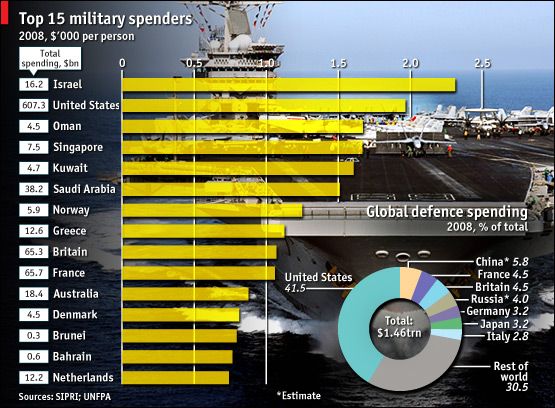
Singapore to have one of the highest defence budget in the world in 2009

Tuesday, 7 July 2009, 5:51 pm

Defence spending around the world (click to enlarge)

From Official Wire:

Singapore’s defence spending will amount to US$11.4bn or 6% of GDP in 2009. As a percentage of GDP, this amounts to one of the biggest defence budgets in recent history.

Singapore has consistently had one of the largest defence budgets in the Asia Pacific region. Given its small population base, Singapore has focused on maintaining its expenditure on sophisticated and superior weaponry. Singapore has consistently spent over 4% of GDP on its defence budget. However, the principal recent development affecting the future of Singapore’s defence spending is the recent rapid deterioration in economic conditions.

Singapore was the first Asian economy to slip into recession in the current global downturn, and will move deeper into recession in 2009.

According to advance estimates by the Ministry of Trade and Industry (MTI), Singapore’s GDP registered a dismal seasonally-adjusted annualised contraction of 12.5% quarter-on-quarter (q-o-q) in Q408 (its worst performance since at least 1980), due to a sharp fall in the services sector. On a year-on-year (y-o-y) basis, GDP contracted by 2.6%, implying that full-year growth for 2008 slowed to just 1.4% from 7.7% in 2007. The manufacturing sector contracted by 9.0% y-o-y in Q408, due largely to falling demand for electronic products in developed markets and a plunge in output for precision engineering.

Defence Minister Teo Chee Hean has announced that defence spending will amount to US$11.4bn or 6% of GDP in 2009. As a percentage of GDP, this amounts to one of the biggest defence budgets in recent history. The Defence Minister stressed the importance of maintaining military spending, noting that threats do not diminish but, rather, often emerge during testing economic times, owing to increased social and political frictions. He noted several factors that had enabled Singapore to build up its defence capability over time: careful spending, sourcing and upgrading second-hand equipment, an ongoing maintenance regime, and investment into research and development.

In February 2009, the Singapore Armed Forces (SAF) announced that they will participate in a US-led task force in the Gulf of Aden designed to target pirates operating in the Gulf and adjacent waterways.

Singapore will supply a landing ship tank, two helicopters and two-hundred personnel. Joining an international flotilla comprising some forty-five warships from Europe, China and Malaysia, the SAF deployment will help to escort vessels traversing the Arabian Sea, Indian Ocean, Red Sea and the Gulf.

Singapore Defence and Security Report Q2 2009

Picture from: Singapore’s defence spending ranked 4th worldwide. Why?